


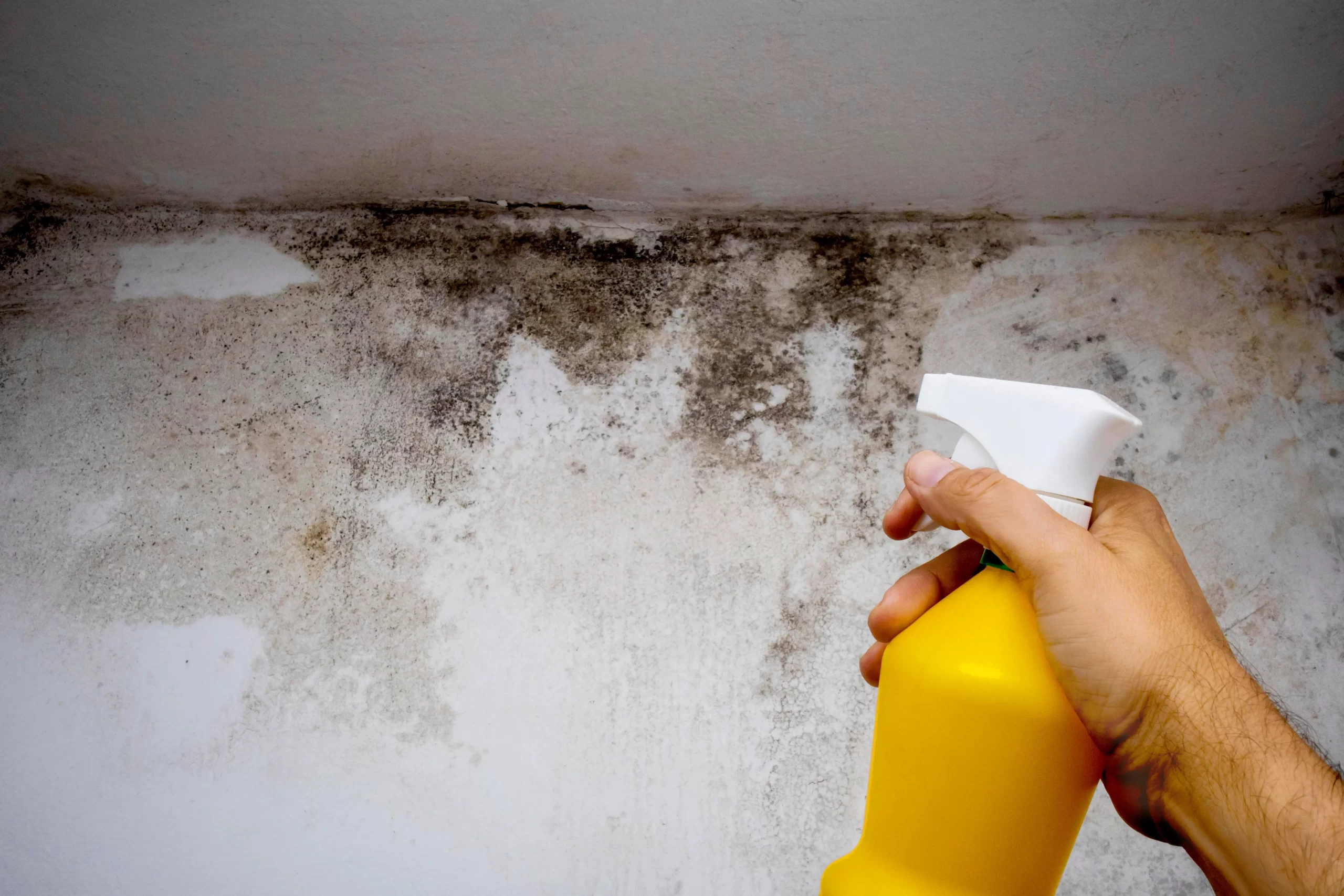
When homeowners in Central Florida discover a dark, fuzzy patch spreading across their walls, their immediate reaction is often to head to the laundry room. For decades, household bleach has been marketed as the ultimate “kill-all” for household germs. However, regarding fungal growth on structural materials, the idea that chlorine bleach is a permanent solution is a widespread misconception. In reality, relying on this chemical can worsen your indoor air quality.
Understanding the science of why does bleach kill mold on drywall, or rather, why it doesn’t, is the first step in protecting your home from long-term structural compromise.
How Bleach Actually Reacts with Active Mold Spores
Bleach is an oxidative cleaner. While it is highly effective at neutralizing bacteria and viruses on non-porous surfaces, mold is a more complex biological organism. The bleach-and-mold myth persists because the visible part of the mold, the fruiting bodies, disappears almost instantly upon contact with chlorine.
However, mold isn’t just a surface stain. It is a fungus with a root-like system called hyphae. Bleach is chemically unable to penetrate the surfaces on which mold grows, meaning the chemical reaction occurs only on the top layer, leaving the living organism beneath entirely intact.
The Critical Difference Between Porous and Non-Porous Surfaces
To understand why bleach fails, you have to look at the “substrate,” or the material the mold is growing on.
Why Tile is Fine, but Drywall is a Disaster
Non-porous surfaces include materials like glass, metal, and glazed ceramic tile. Because the mold stays on top of these hard surfaces, bleach can effectively reach the spores and wipe them away. This is why bleach is often recommended for cleaning bathroom grout or tile.
Drywall, however, is a highly porous material made of gypsum and paper. It acts like a giant sponge. When mold grows on drywall, it sends its roots deep into the core of the panel. Because the chemical structure of bleach prevents it from soaking into these pores, it never reaches the source of the infestation.
Why Bleach Leaves the Mold “Roots” Alive Inside Your Walls
The molecular structure of household bleach is the primary reason it fails on walls. Chlorine, the active disinfecting agent, has a high surface tension. This prevents it from seeping into the microscopic pores of wood or drywall.
When you spray a bleach solution on a moldy wall, the chlorine stays on the surface while the water carries the mold deeper into the material. You’ve effectively performed a “chemical haircut.” You’ve trimmed the visible top of the mold, but the roots remain alive inside the wall, waiting for the right moment to grow back even stronger than before.
The Water Content Problem: How Bleach Actively Feeds the Mold
Perhaps the most ironic part of using bleach is that you are inadvertently feeding the very problem you’re trying to solve. Household bleach typically contains 90% to 94% water.
Mold requires three things to thrive: a food source (cellulose), oxygen, and moisture. When you apply bleach to a porous surface, the chlorine evaporates quickly into the air, but the water stays behind, soaking deep into the drywall. You are essentially providing a massive “drink” to the mold roots. Many homeowners find that after a week or two, the mold returns with a vengeance because of this extra hydration.
The Discoloration Illusion: Why the Mold Looks “Gone” (For Now)
Bleach contains whitening agents that remove pigments from mold spores, turning them clear or white. This creates a dangerous “discoloration illusion.” You look at the wall and see a clean surface, leading you to believe the mold removal was a success.
In reality, the mold is still there; it’s just invisible. While you assume the area is safe, the fungus continues to digest the paper backing of your drywall. By the time the dark color returns, the wall’s structural integrity may already be compromised, potentially requiring full demolition.
The Real Health Hazards of DIY Bleach Treatments
Beyond its ineffectiveness, using bleach as a DIY mold solution carries significant health risks.
Toxic Fumes and the Danger of Poor Ventilation
Chlorine bleach releases strong fumes that can irritate the eyes, skin, and respiratory tract. If bleach is accidentally mixed with other household cleaners containing ammonia, it can create deadly chlorine gas. Furthermore, the act of spraying and scrubbing mold without proper containment can cause “spore aerosolization,” where millions of microscopic spores are launched into your home’s air supply and HVAC system.
Effective, Safe Alternatives for Minor Surface Cleaning
If you are dealing with a very small area (less than 10 square feet) on a non-porous surface, there are safer ways to handle how to kill mold on porous surfaces without the harsh side effects of bleach:
- Distilled White Vinegar: The acidity in vinegar can penetrate porous materials more effectively than bleach.
- Hydrogen Peroxide: A 3% concentration is an effective antifungal that is less corrosive than bleach.
- Borax: A natural mineral that cleans and inhibits future mold growth without emitting toxic fumes.
The True Cost of Botched DIY Mold Removal
The “cheap” DIY fix often ends up being the most expensive route. When a homeowner uses bleach and thinks the problem is solved, they often stop looking for the source of the moisture. Meanwhile, the mold continues to spread behind the baseboards. What could have been a localized mold remediation project can quickly turn into a whole-home contamination.
When to Call Orlando’s Mold Remediation Pros
In Florida’s humid climate, mold isn’t just an aesthetic issue; it’s a race against time. If you see mold spreading or smell a musty odor but can’t find the source, it is time to stop the DIY experiments.
Professional mold removal involves much more than just applying a cleaning solution. Experts use specialized tools to ensure the problem is gone for good:
- Containment: Using HEPA-filtered air scrubbers to ensure spores don’t spread.
- Structural Drying: Using industrial dehumidifiers to remove the moisture that mold needs to survive.
- Antimicrobial Encapsulation: Using specialized coatings that kill mold roots and prevent regrowth.
Don’t bet your home’s health on a bottle of laundry cleaner. If you suspect a serious problem, our team at Mold Remediation of Orlando is here to help you. We have the tools and experience to identify the root cause of the moisture and eliminate the mold for good.
